Industrial Pressure Sensor Selection Guide: 5 Core Technologies & Applications
Aug 13,2026 | simplybuy industrial
1. 5 Core Pressure Sensing Technologies Explained
While the electronic blocks inside industrial pressure sensors look similar across brands, their underlying working principles dictate how well they perform in demanding real-world conditions.
Piezoresistive (Strain Gauges)
-
How It Works: Tiny electrical resistors are bonded to a flexible silicon or metal diaphragm. As pressure flexes the diaphragm, the resistors stretch, changing their electrical resistance.
-
Key Advantages: Rugged solid-state design capable of withstanding severe hydraulic pressure spikes and mechanical shocks.
-
Best Applications: General industrial machinery, high-pressure hydraulic loops, and heavy fluid systems.
Capacitive Arrays
-
How It Works: Tracks the displacement between a flexible front plate and a fixed parallel backing plate. Applied pressure changes the gap and alters the capacitance.
-
Key Advantages: Exceptional sensitivity to micro-movements and low-pressure fluctuations.
-
Best Applications: Pneumatic pressure monitoring, HVAC airflows, and precision cleanroom environments.
Piezoelectric Crystals
-
How It Works: Uses specialized crystalline materials that generate an electrical charge when physically compressed.
-
Key Advantages: Ultra-fast response rates for measuring rapid force transitions and dynamic pressure events.
-
Best Applications: High-frequency vibration analysis, dynamic explosion testing, and engine combustion monitoring.
Optical / Fiber-Optic
-
How It Works: Runs fiber-optic cables to monitor how light beams refract or bounce inside the sensor head as pressure changes.
-
Key Advantages: Zero electrical current reaches the pipe fitting—eliminating spark hazards and providing complete immunity to motor static or electromagnetic interference (EMI).
-
Best Applications: Volatile chemical lines, explosive environments, and high-EMI power generation facilities.
Resonant Elements
-
How It Works: Uses microscopic internal beams vibrating at a high, preset frequency. Pressure on the diaphragm shifts the tension and vibration pitch of the beam.
-
Key Advantages: Delivers the highest level of measurement precision and long-term stability.
-
Best Applications: Calibration benches, laboratory testing, and critical fiscal metering.
2. Choosing the Right Reference Baseline (Gauge, Absolute, Differential, Sealed)
Selecting the correct zero baseline is critical for eliminating tracking errors and safety blind spots in your automation line:
-
Gauge Pressure: Uses ambient atmospheric air as zero reference (via a small vent tube). Ideal for open-tank liquid level sensing and standard plant air lines.
-
Absolute Pressure: Referenced against a sealed internal vacuum chamber ($0\text{ bar}$). Immune to weather and altitude shifts; ideal for vacuum packaging and chemical distillation columns.
-
Differential Pressure: Features dual process ports to calculate the exact pressure difference between two points. Essential for inline filter clogging detection and flow velocity measurement.
-
Sealed Pressure: Uses a sealed internal chamber pre-set to standard sea-level pressure. Protects internal electronics from water/chemical ingress without requiring an external vent tube.
3. Industrial Application Selection Matrix
| Environment | Typical Pressure Range | Core Operational Challenge | Recommended Sensor Technology |
| Hydraulics | 100–700+ bar | Fluid hammer shocks, high static loads | Thick piezoresistive metal diaphragms |
| Pneumatics | 2–10 bar | Fast response time, zero leakage | Thin-film piezoresistive or capacitive arrays |
| Heavy Industry (Slurry/Heat) | Varies widely | Abrasive clogging, seal degradation, thermal shock | Flush-mount welded metal diaphragms with ceramic insulation |
Deep-Dive Application Analysis
-
Hydraulic Systems: Fast valve cycling generates severe fluid-hammer shocks that can fracture delicate internal components. Piezoresistive diaphragms feature a rigid, solid-state build that absorbs these shocks without calibration drift.
-
Pneumatic Lines: Operating at lower pressures, pneumatics require instant feedback so the PLC can adjust regulator valves in real time. Thin-film piezoresistive and capacitive sensors excel here due to their fast response times.
-
Slurry & High-Heat Processing: Heavy media in paper mills and cement plants easily clog standard narrow ports. Flush-mount diaphragms eliminate dead space where debris accumulates, while ceramic insulation protects the electronics from high-temperature cycling.
4. Legacy Mechanical Designs Still in Service
Purely mechanical designs predating solid-state electronics are still widely used for local direct readings:
-
Aneroid Barometers: Flexing metal capsules driving a direct mechanical dial. Durable and simple, but too slow for dynamic PLC feedback.
-
Manometers: U-shaped liquid-filled tubes that measure pressure via liquid column height. Highly accurate for lab calibration, but unsuited for automated production lines.
-
Bourdon Tubes: Coiled metal tubes that straighten under pressure to drive a pointer. Cost-effective for high-pressure local gauges, but vulnerable to vibration.
-
Pirani Vacuum Sensors: Heated filaments that lose heat based on surrounding gas density. The standard choice for low-vacuum ranges in semiconductor manufacturing.
5. Featured Product & One-Stop Automation Sourcing
Finding the right sensor requires balancing mechanical durability with a reliable global supply chain.
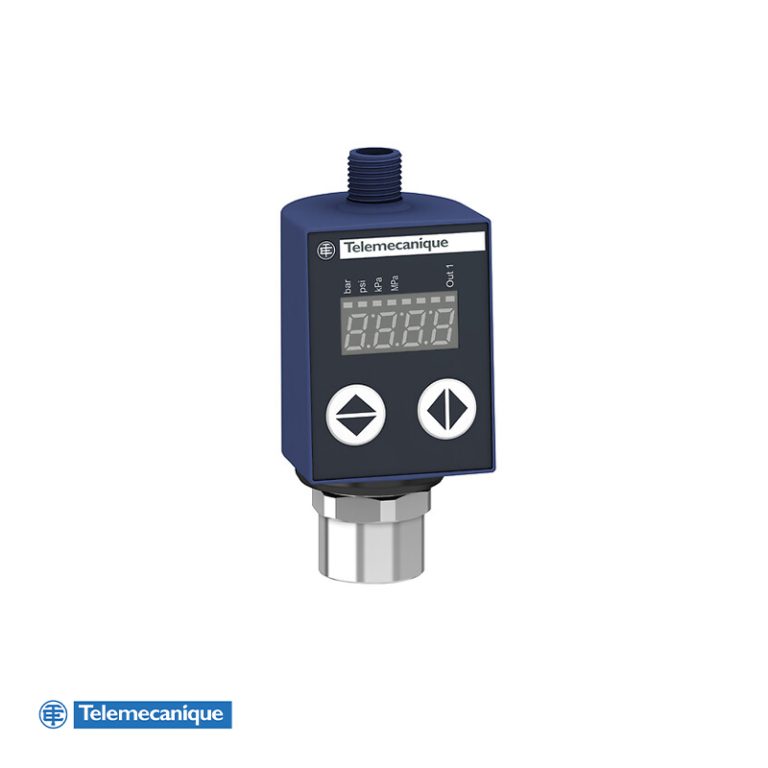
🌟 Featured Stock: Telemecanique OsiSense XM Pressure Sensors
-
Manufacturer: Telemecanique (Schneider Electric Group)
-
Operating Voltage: 24 VDC (12 to 33 V limits)
-
Response Time: ≤ 2 ms (10% to 90% of full scale)
-
Dual Output: Adjustable discrete switching point + 3-wire 0-10V analog output (provides trip signals and continuous feedback in one unit)
-
Protection & Durability: IP65 / IP67 / IP69K rated; mechanical durability up to 10 million cycles
-
Ideal Applications: Hydraulic pressure monitoring and general automated fluid loops
Comment